Showing posts with label pastry. Show all posts

Wednesday, January 3

2007...

A new year, a new beginning.
Good resolutions, firework, lots and lots of oliebollen and a chance for 20 million in the new years eve lottery.
That last one didn’t come true of course, but the oliebollen part made it up quite all right…

As I already let you know with my ‘Things to Eat before You Die’-list, oliebollen are one of my favourite things in the world.
But, needless to say, only oliebollen from my family recipe. The average bol that is sold during this time of year in the special pastry stalls is a bit too greasy for my taste and has nothing, or maybe, when you’re lucky, 4 raisins as filling. Not really my taste. We like our bollen as they were made intentionally: properly filled. The trick is to use eggs, lemon zest ànd juice and lots and lots (and lots) of apples, raisins and currants. A delicious, sweet, airy and moist bol with a golden brown, crispy layer will be the result.

I love oliebollen. It’s strange you can attach so much to customs; it happens still occasionally through the year, mid June for example, that I would kill for a fresh, still warm bol - we however haven’t made them ever on a different day then the 31st. It’s just not right. We wait a year, and then eat for 3 days nothing else than oliebollen. Period. (and we are of course at least a month sick of them afterwards…) ;)

Oliebollen are one of the most well-known Dutch things. Although not everybody makes them their selves, making them is in our family a true tradition. We start bright and early with our batch, call how it’s going with the others and the next day tasting and comparing the golden beauties with the rest…

So, a new year.
"Let's hope it's a good one, without any fears."
Up to new starts, hopes, wishes, opportunities and chances.
And of course...Tasting Life!


Superbollen, Oliebollen
(“dough balls”) makes about 45
- 800g (6 cups) flour
- 16g (1 Tbsp) salt
- 4 eggs
- 40g fresh yeast
- 0.6L (2 ½ cups) milk
- 2 Jonagold apples
- 3 Goudreinet apples (if you don’ have these apples, just use firm, sour apples)
- 200g yellow sultana raisins,
- 200g blue sultana raisins,
- 200g currants
- 3 lemons - the zest of 3 lemons, and the juice of 1/2 lemon
- 100g (1 stick/½ cup) butter

- a deep-frying pan with fresh deep-frying fat (sunflower oil)
- kitchen paper and napkins
- powder sugar

1. In a small saucepan, heat about 0,2L (1 cup) of the total 0.6L until it’s tepid. (about 40°C - 104°F) Pour the warm milk in a small bowl and crumble the yeast over it. Stir gradually until it’s completely dissolved, cover up and set to rest on a warm place.

2. Peel the apples, chop them in 4 pieces, remove the core, and cut the parts into tiny little pieces. Put the apples together with the raisins, currants, lemon juice and lemon zest in a large bowl and mix well.

3. In the biggest basin you have, (or a clean bucket) sift together the flour and salt. Make a small hole in the centre and insert one egg. Mix with the electric mixer fitted with the dough hooks until the egg is completely inserted. Then add the second egg and repeat this process until all eggs are added.
In a small pan, melt the butter. Heat in the ‘milk’ pan the rest of the milk until tepid.
Add to the flour/egg mixture the yeast mixture that was resting and mix until well blended. Add the rest of the milk and mix until combined, to end with mix the melted butter in. Change the dough hooks for the whisk hooks and mix until the whole mixture is one smooth mass. Scoop the filling in, mix well, cover up with a damp towel and set to rest on a very warm place for 1 to 2 hours. Now the dough will have risen and doubled in its size…

4. Heat the deep-frying fat until it reaches 180ºC. take an ice scooper or two tablespoons and stick the spoons in the heated fat for a couple of seconds. (this will prevent the batter from sticking to the spoons) take a big spoon full of dough, round it a bit, and carefully dip it into the oil. Repeat this, but don't have more than 6 of them into the oil at the same time (this also depends on the size of your pan). Fry the 'oliebollen' for 6 minutes, 3 for each side, until they are nice gold brownish.


5. Take the oliebollen out and let them leak out on kitchen paper until they are completely dry. Serve warm or cold with lots and lots of powder sugar. The oliebollen will keep for 2,3 days, but they are best the first day. Keep them in a bowl covered with a towel.

Monday, October 2

Paris Time: Chocolate Éclairs

I love watching TV series while I peel peanuts, my cat Romeo, morning fog, cherries, the smell of Christmas trees, my family -
But I as well love Paris.
Nothing overdramatic or something to exaggerate, but still a kind of special, distinctive feeling which I can not really explain. My tummy flips when I’m daydreaming about living there and I just simply want to be in Paris -

Well, maybe you’ve already noticed my count down here on the right… but in 24 days I will be on my way to Paris; city of lights and love, shopping paradise and gourmet walhalla (!)
I can’t wait to stroll down the Champs Elysee, taking the Paris metro, having some macarons again, sipping on my café au lait, exploring the different arrondissements a bit better and purchase some new winter fashion - which nobody will have here in Holland, wha-ha... -
I’m going for 3 days with my mum and sister and I can’t wait - (and it will be a true miracle if I will get to see and do everything that’s already on my list…)

I’ve only been 2 times in Paris, both for my birthday - when I was 10 and last year, for my 15th birthday. To get (even more) in the Paris mood, I decided to try and make éclairs. Chocolate éclairs.
I only have had 3 or 4 éclairs in my life; all in Paris at Fauchon, Maison du Chocolat and bakery Paul.
So the stakes and expectations were rather high…

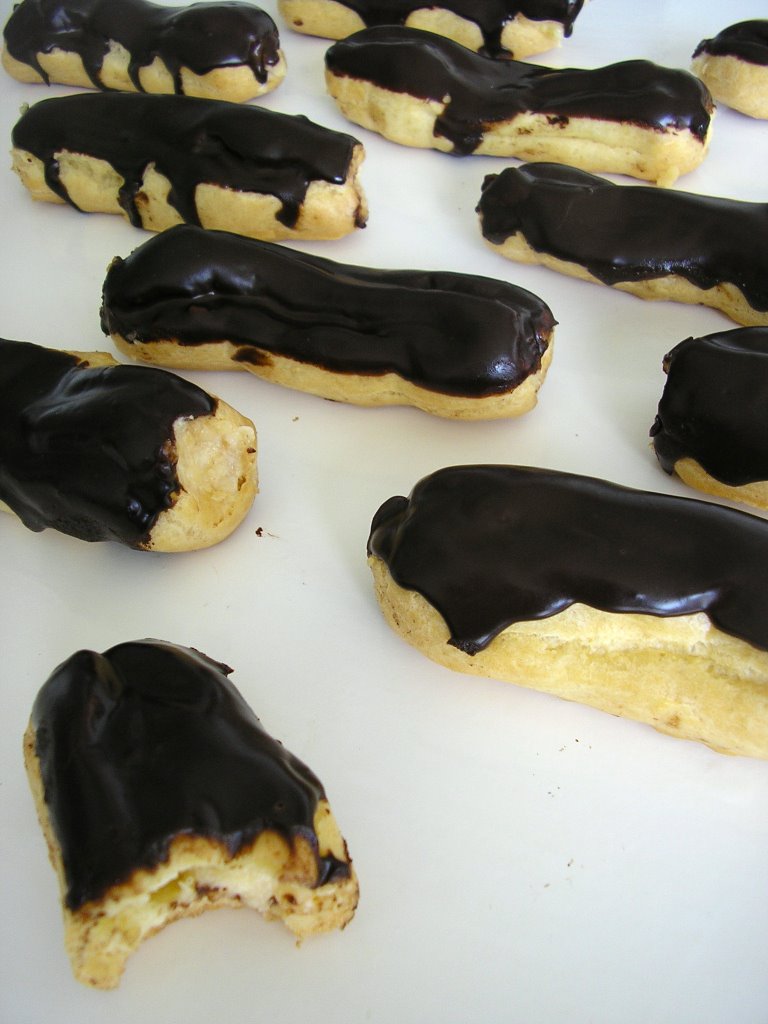
Luckily the whole process went very smoothly and as you’ve already seen on the first photograph…
my own éclairs turned out beautifully and very delicious.
They are not quite yet in the same league as Fauchon’s, but this is truly a great recipe and it did give a real similar feeling as the one from last year…

I actually don’t really like custard or things filled with pastry cream - I’m not that keen on profiteroles or millefeuilles
but this cream filling - o my god
This pastry cream is different, slightly vanilla-infused and it is much lighter, as a result of adding whipped cream into the batter.
This is very nice, and will make it possible to devour 5 or 6 Éclairs easily without needing any pause…

It was a lot of work, definitely if you compare it with the time it took to gobble them down…, but all worth it.
And who knows…if things go as I want, maybe you can have one someday at JULIA instead of Fauchon… ;)


Chocolate Éclairs (makes 30)
Pâte à choux:

- 115g (1stick/½ cup) butter, cut into pieces
- 1 tsp sugar + ½ tsp salt
- 150g (1 ¼ cups) all-purpose flour
- 4 large eggs (plus 1 egg white, if needed - I didn’t need it)

Pastry cream:
- 500ml (2 cups) whole milk
- 100g (½ cup) sugar
- ½ vanilla bean, split lengthwise, seeds scraped (or 1 tsp vanilla extract)
- pinch of salt
- 4 egg yolks
- 75g (¼ cup) cornstarch 2 Tbsp butter, cut into small pieces

Chocolate glaze:
- 170g (6 ounces) bittersweet chocolate, finely chopped
- 565ml (2 ¼ cups) heavy cream
- 1 Tbsp honey

1. Begin with the pastry cream:
In a medium saucepan, combine milk, half of the sugar, vanilla and salt.
Cook over medium heat until mixture comes to a simmer.

In a medium bowl, whisk together the egg yolks, cornstarch, and remaining sugar. Whisking constantly, slowly pour 100ml (½ cup) of the hot-milk mixture into the egg-yolk mixture. Continue adding milk (100ml/½ cup at a time) until it has been incorporated.

Pour mixture back into the saucepan, and cook over medium-high heat, whisking constantly, until it thickens.
Transfer to the bowl of an electric mixture fitted with the paddle attachment. Add the butter, and beat on medium speed until the butter melts and the mixture cools, about 5 minutes.

Cover with plastic wrap, pressing it directly onto the surface of the pastry cream to prevent a skin forming. Refrigerate until chilled, about 2 hours (or up to 2 days!) just before using, beat on low speed until smooth.

2. The pâte à choux:
Preheat oven to 210°C (425°F)
In a medium saucepan, combine butter, sugar, salt and 240ml (1 cup) water. Bring to a boil over medium-high heat, and immediately remove from heat. Using a wooden spoon, quickly stir in the flour until combined.
Return pan to medium-high heat, and cook, stirring constantly, until mixture pulls away from the sides, about 3 minutes.

Transfer mixture to the bowl of an electric mixer fitted with the paddle attachment. Mix on low speed until slightly cooled, about 1 minute.
Increase the speed to medium, and add the whole eggs, one at a time, beating until each is incorporated before adding the next. Test the batter by touching it with your finger and lifting to form a soft peak. If a soft peak does not form, the batter needs more egg. If you have added all the whole eggs and the batter still does not form a soft peak, lightly beat the remaining egg white, and add a little at a time.

3. Making Éclairs out of the pâte à choux:
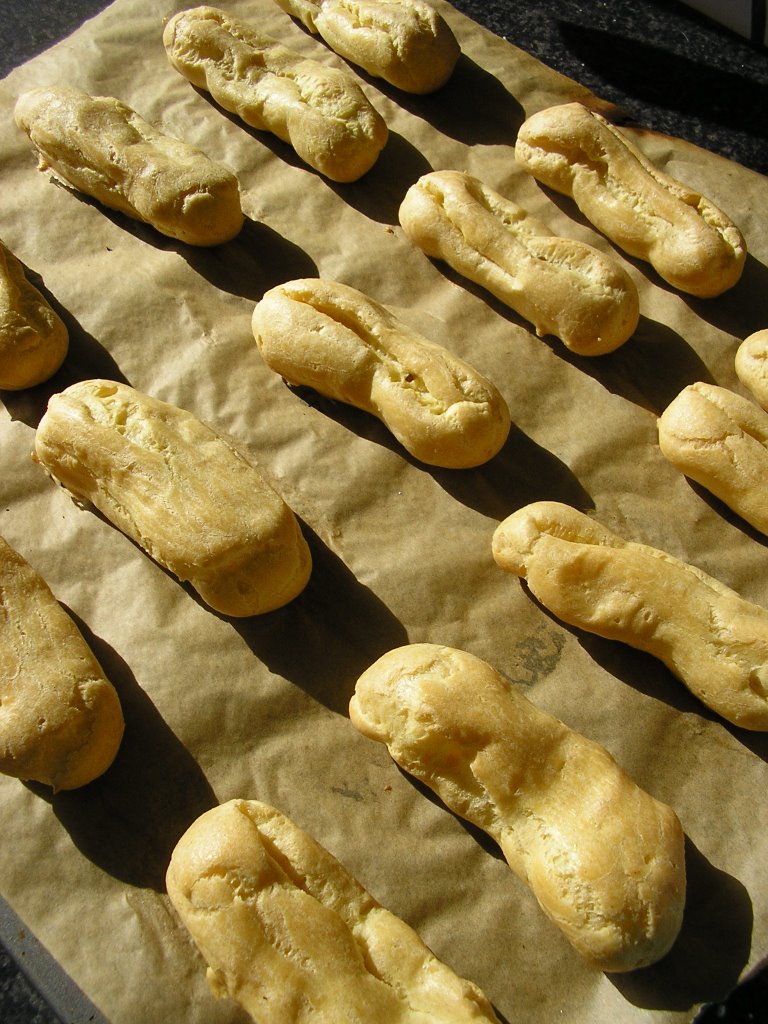
Line two large baking sheets with parchment paper. With a ruler and a pencil, mark lines about 8 cm (3 ½ inches) long on the parchment paper, spacing them about 5 cm (1 ½ inches) apart. I got 15 on my sheet.
Turn parchment paper over, marked sides down (otherwise your Éclairs will have little lines on their back…!)

Fill a pastry back with pâte à choux and pipe along the lines on the prepared baking sheets - about 1 cm (½ inch) thick. Gently smooth tops with a wet fingertip to ensure even rising.


Bake for 10 minutes and reduce oven temperature to 180°C (350°F).
Continue to bake, rotating sheets halfway through, until pastries are golden brown, 25 to 30 minutes more. Transfer pastries and parchment paper to a wire wrack to cool completely.


4. Make the chocolate glaze:
Place chocolate in a heatproof bowl. (large enough that an Éclair could fit in lengthwise)
Heat 190ml (¾ cup) cream and the honey in a small saucepan over medium heat until bubbles begin to appear around the edges, about 5 minutes. Pour mixture over the chocolate. Let stand for 5 minutes, then stir until smooth. Let cool, stirring occasionally, about 5 minutes.

5. Filling the Éclairs:
With the same pastry tip (cleaned of course!) create a small hole on both sides of each shell.

Take the pastry cream out of the fridge and in a medium bowl, stir to soften.
In another bowl, whip the remaining 375ml (1 ½ cups) heavy cream to stiff peaks. Fold the whipped cream into the Pastry Cream in two batches to lighten.
Transfer to a pastry bag fitted with the same plain 1cm (½ inch) tip.
Insert the tip into the opening of each Éclair shell - both sides - and pipe to fill with the whipped pastry cream. You’ll feel when the Éclair is filled - you’ll feel pressure and the shell will be a lot heavier…

Dip the top of each Éclair into the chocolate glaze; let excess drip off, and place, coated sides up, on a wire rack set over a baking sheet.
Refrigerate Éclairs in a single layer in an airtight container until glaze is set, about 20 minutes or up to 2 days…


Thursday, August 31

Salty Triangle Biscuits

Because this following recipe should really come with a warning, thoughtful as always, I added it in for you...
warning:
It is very likely once you’ve tasted one of these totally luscious crisps, and you’ve got the rich addictive flavour remaining in your mouth, many, I really mean many, will follow and you will find yourself devouring the entire pile.
So a great self-control is needed.
Because I apparently don’t have that, an entire pile did follow and now we refer to them simply as ‘de lekkere ziekmakertjes’ - translated ‘the delicious little sickmakers’

I found the original recipe for these salty biscuits in Martha Stewart’s Baking Handbook.
I don’t know what it is but I always pick out recipes that are paired with a nice picture. The art of good photography really gets me and makes me unconsciously craving for all their tasty looking delicacies. I simply can’t get a recipe out off my mind after I’ve seen the beautiful, flawless, tempting photograph.
So after seeing Martha Stewart’s mouth-watering photograph of these lovely golden-brown cookies, there was no question. I just had to make them.

Martha titled them ‘Savoury Caraway Cheese Crisps’ but you can’t really taste the mascarpone and the caraway seeds weren’t such a success so I thought they would be better of as ‘salty triangle biscuits’ and I changed it.

These cookies are surprisingly rich and light at the same time. Flaky, with a subtle, soft flavour and very irresistible. They are dry, o so buttery and they will become deliciously soft and oozy on your tongue while chewing.
Perfect for an afternoon snack or appetizer, they were also much enjoyed the next evening with a light salad.

Salty Triangle Biscuits
(makes about 5 dozen)
- 400 g (2 ¾ cup) sifted all-purpose flour, plus more for dusting
- ½ tsp baking soda
- ½ tsp salt
- 55 g (¼ cup) sugar
- 200 g (2 sticks/1 cup) unsalted butter, at room temperature, cut into pieces
- 250 g (8 ounces) mascarpone cheese
- 1 large egg
sprinkling:
- coarse sea salt
- sesame seeds
- optional: your favourite herbs/spices

1. In the bowl of an electric mixer fitted with the paddle attachment, mix the flour, baking soda, salt and sugar. Add the butter, one piece at a time, beating until the mixture resembles coarse meal.

2. Add the mascarpone and beat until a soft dough forms, scraping down the sides of the bowl as needed.

3. Turn out the dough onto a clean surface and divide it in half. Shape each into a flattened square, wrap in plastic and refrigerate at least one hour or overnight.

4. Preheat the oven to 175°C (350°F) Line two large baking sheets with parchment paper and set aside.

5. Take the dough out of the fridge and roll each piece thinly out into a big square on a well-floured work surface. Using a pizza wheel or sharp knife, cut the dough square into triangles. (They should be roughly the same size, but the shapes don’t have to be uniform) Place them on the prepared baking sheets.

6. In a small bowl, whisk together the egg and 1 tablespoon water. Brush each triangle with egg wash. Sprinkle some with sea salt and the others with sesame seeds.

7. Bake for 15 to 18 minutes, until the crisps are golden brown. Transfer to a wire rack to cool completely. Crisps can be kept in an airtight container at room temperature for up to 3 days.

Saturday, August 5

Spanakopita (Greek spinach pie)

Because my inquiry for The Perfect Scone is still full going, I unfortunately have to report that it’ll take a bit longer. But don’t worry, results are still being booked and with every adjustment there is improvement.
(the only backside is that every day I stumble on more and more recipes...)

In the meantime I though it might be nice to share the recipe for Greek spinach pie with you guys; my ultimate favorite dish.


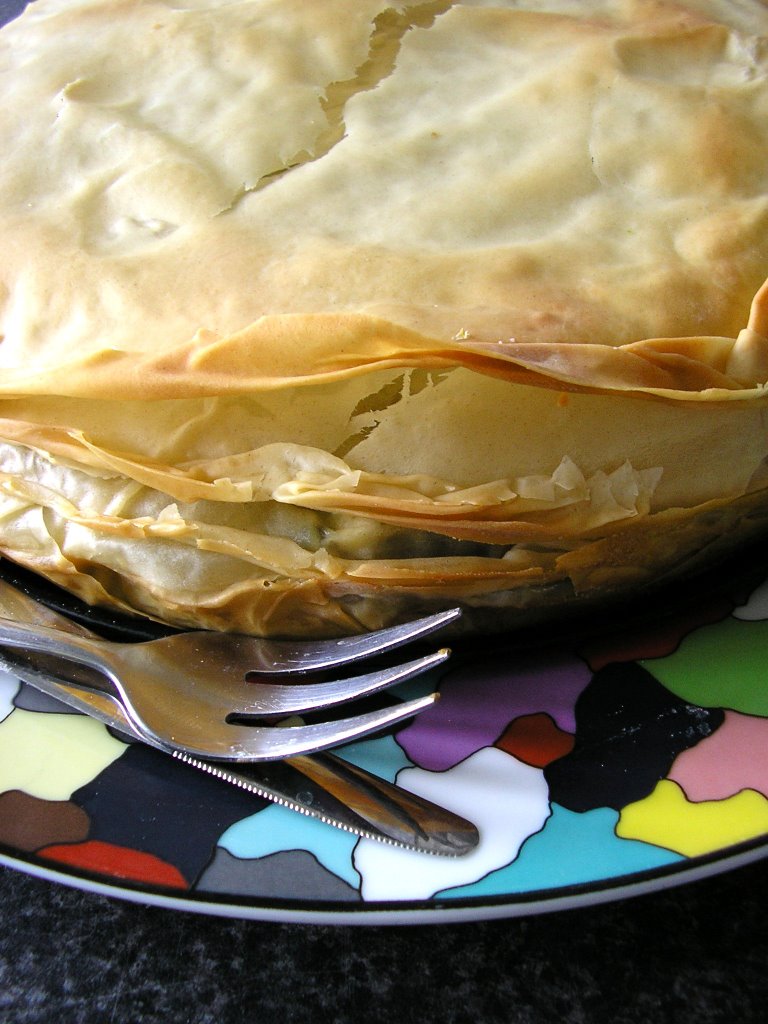
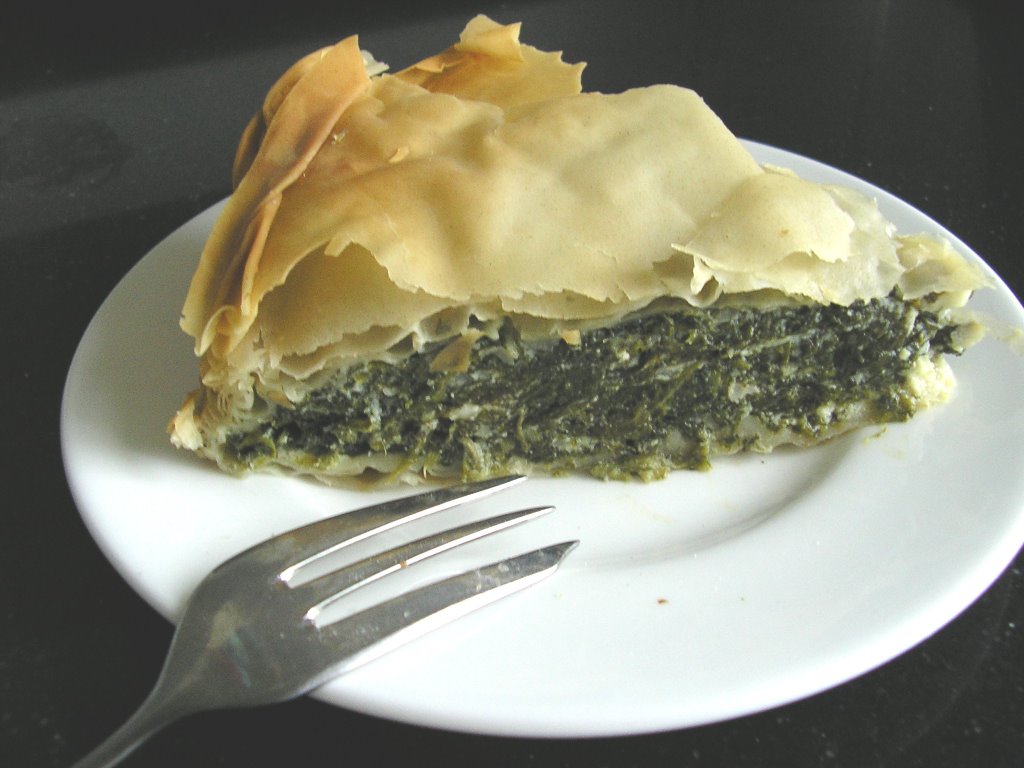
Just look at it; it’s perfect.
I simply can’t resist it; even now I’m already a little drooling…
It’s the best food you can EVER serve me. (OK, this is maybe a bit of an overstatement; I can change my mind on this later on, with al the recent baking, but for NOW it certainly is!)

When I have a slice, I think of my vacation to Greece, where I first tasted this delicious tart and ate it happily and relaxed as lunch in the cafeteria by the beach… *sigh*

The phyllo dough is wonderfully crisp (but not hard!) and dry and becomes beautifully golden brown in the oven. This paired with the slightly moist and overwhelming strong and rich taste of spinach is magnificent. Its very light and compact pastry and it’s very nice to serve on a party buffet. I like it best when it’s served cold.
The leftovers (if there are any…) are as well delicious to eat the next day; the spinach becomes than even stronger and the puff pastry will be slightly softer and oozier. Best to serve straight out of the fridge.

Greek spinach pie


- 3 Tbsp olive oil + more for brushing
- 1 large onion, chopped
- 2 cloves garlic, minced
- 1 bunch green onions, chopped
- 1 kg spinach, rinsed and chopped
- a handful fresh parsley
- 2 eggs, lightly beaten
- 125 g ricotta cheese
- about 125g FRESH feta cheese, crumbled
- 8 sheets phyllo dough

1. Take the phyllo dough out of the freezer, preheat oven to 175˚C and lightly oil a 24 cm (or a bit smaller…) round spring form.

2. Heat 3 Tbsp olive oil in a large pan on medium heat. Sauté onion, garlic and green onions, until they’re soft and lightly browned. Stir in, in parts, the spinach and parsley, continue to sauté until the spinach is limp. This will take about 5 minutes. Add salt and pepper to taste. Remove from heat and set aside to cool.

3. In a medium bow, mix together eggs, ricotta and feta. Stir in the spinach mixture.

4. Lay one sheet of phyllo dough in the spring form and lightly brush it with olive oil. (do this carefully, it’s important that every part get brushed!) Lay another sheet on top of this, brush with olive oil and repeat this process until you have 4 layers of phyllo dough. (it doesn’t matter if the sheets cover a bit of the pans sides)

5. Spread spinach mixture into the pan. Layer the remaining 4 sheets of phyllo dough on top of this, each carefully brushed with olive oil. Tuck overhanging dough into the pan to seal the filling.
6. Bake for 40 minutes, until golden brown. (I my case this doesn’t happen, so I also put the broiler on for about 10 minutes.) Take the pie out of his form and serve hot or cold.